Beyond Credit: Building Women Leaders, Not Just Borrowers

By
V P Nandakumar
CMD, Manappuram Finance Ltd
For decades, the story of financial inclusion in India was told in the language of access: how many bank accounts were opened, how many loans were disbursed, and how many first-time borrowers were brought into the formal fold. It was a necessary beginning. Yet, traditional banks struggled to serve a significant segment of low-income Indians — particularly women — for whom servicing small-ticket loans made little commercial sense.
Microfinance institutions emerged precisely to close this gap. Using community-based models, streamlined paperwork, and micro-lending, they brought millions of rural and semi-urban borrowers into the formal financial system for the first time.
That story, while impressive, remains incomplete. A loan, however well-designed, is only the first rung of a much longer ladder. It can fund a sewing machine, a kirana shop, or a dairy unit, but it cannot by itself teach a woman how to price her product, negotiate with suppliers, or confidently manage her household budget. Access to credit and the capacity to use it effectively are two very different things — and for too long, our sector assumed that solving the first automatically resolved the second.
This is why forward-looking microfinance institutions are quietly redefining their purpose — moving from credit providers to enablers of holistic empowerment. The shift begins with something deceptively simple: financial literacy. Training women in budgeting, savings discipline, interest calculations, and digital payments does more than cultivate reliable borrowers; it builds confident decision-makers who no longer need to route every financial transaction through a husband, brother, or moneylender. It marks the difference between a woman who merely repays a loan and one who manages financial strategy.
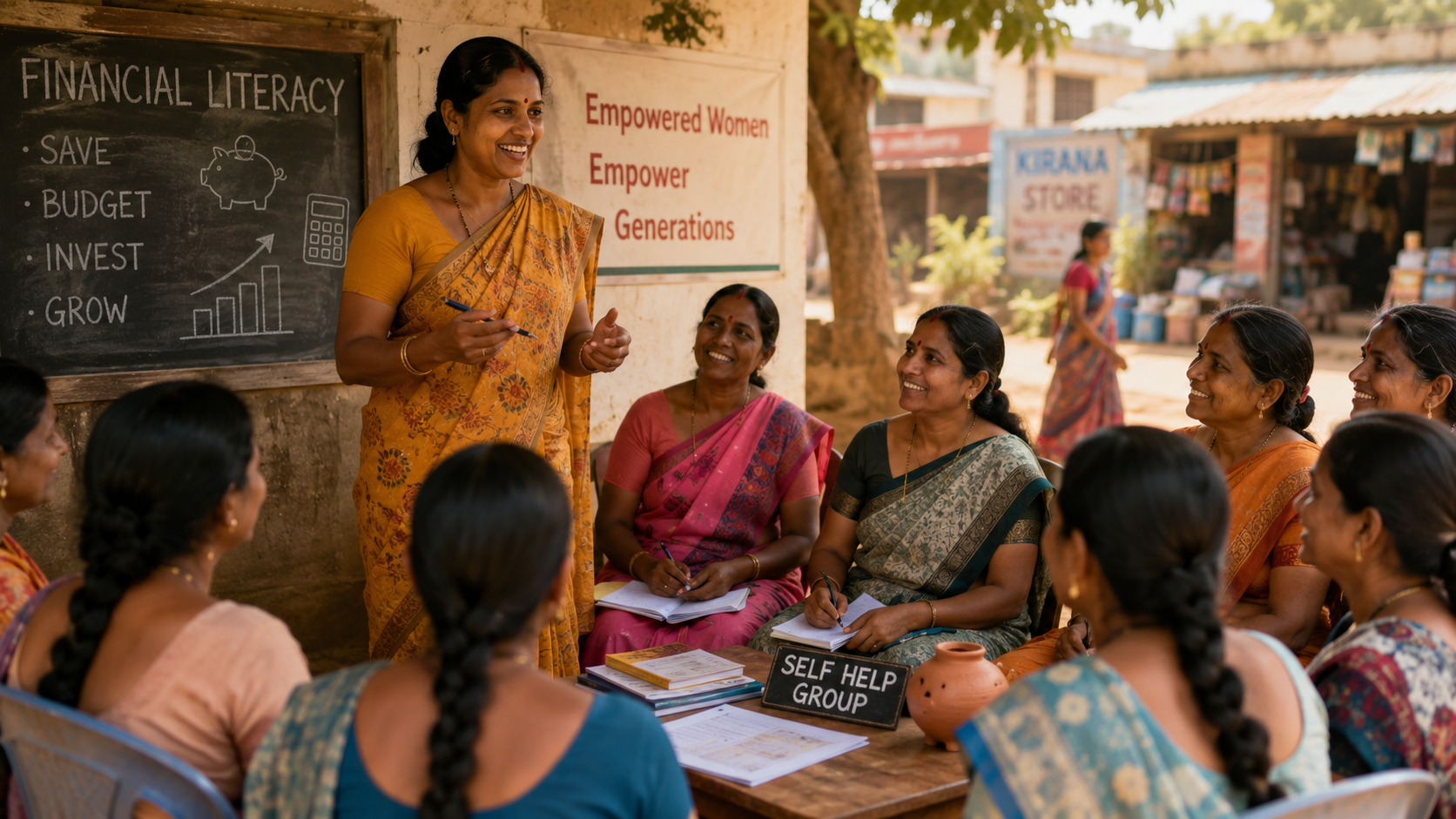
Financial literacy, however, is only the entry point. The institutions excelling at this transformation are going further — building negotiation skills, encouraging peer discussions on business challenges, and instilling entrepreneurial thinking early so women learn to anticipate market dynamics rather than react to them. The result is a visible transition from “borrower” to leader: a woman who not only runs a enterprise, but is recognized within her family and community as someone whose judgment carries weight.
Nowhere is this shift clearer than in the community platforms that have grown around the microfinance movement — Self-Help Groups (SHGs), Joint Liability Groups (JLGs), and federated collectives. By rotating leadership, practicing collective decision-making, and resolving operational disputes routinely, these groups function as grassroots leadership incubators. Programs like Kerala’s Kudumbashree (spanning over 45 lakh women) and Maharashtra’s MAVIM demonstrate what structured community organization can achieve — women who began as loan recipients now govern local councils, run large federations, and mentor emerging entrepreneurs.
This impact extends far beyond individual households. A woman who gains a business skill or the confidence to trade rarely keeps that knowledge to herself; she mentors her neighbor, who in turn guides another, compounding the benefit across the community. Empowered women prioritize education for their children, advocate for better local healthcare and sanitation, and step into public leadership. This is the multiplier effect that no disbursement statement can capture, yet it is arguably the most consequential outcome of our work.
None of this diminishes the importance of credit — it remains the essential foundation. But responsible NBFCs and MFIs increasingly recognize that their duty cannot end at disbursement. It must extend to financial education, ethical lending practices, and genuine investment in the long-term capability of borrowers, rather than just their repayment capacity. Done well, this is where financial inclusion and meaningful social impact converge.
The future of microfinance will not be measured solely by the volume of capital deployed. It will be measured by how many women — once simple borrowers — become the primary drivers of progress in their homes, businesses, and communities. That is the real balance sheet our sector must build toward.
Pic Courtesy: google/ images are subject to copyright