The Neuroscience of Success: Why Some People Achieve More Than Others

By, DR ARUN OOMMEN
MBBS, MS ( Gen Surg), Mch( Neurosurgery),MRCSEd (UK), MBA, ENLS, DLitt(H), PhD(H), DSc (H),DMS,
Senior Consultant Neurosurgeon,
VPS Lakeshore Hospital
Kochi, India
“The Surprising Truth: Success Is Not Just About Intelligence”
Imagine two children sitting in the same classroom.
One becomes a world-renowned scientist. The other struggles to keep a steady job. Both had similar teachers. Similar opportunities. Similar intelligence.
So what made the difference?
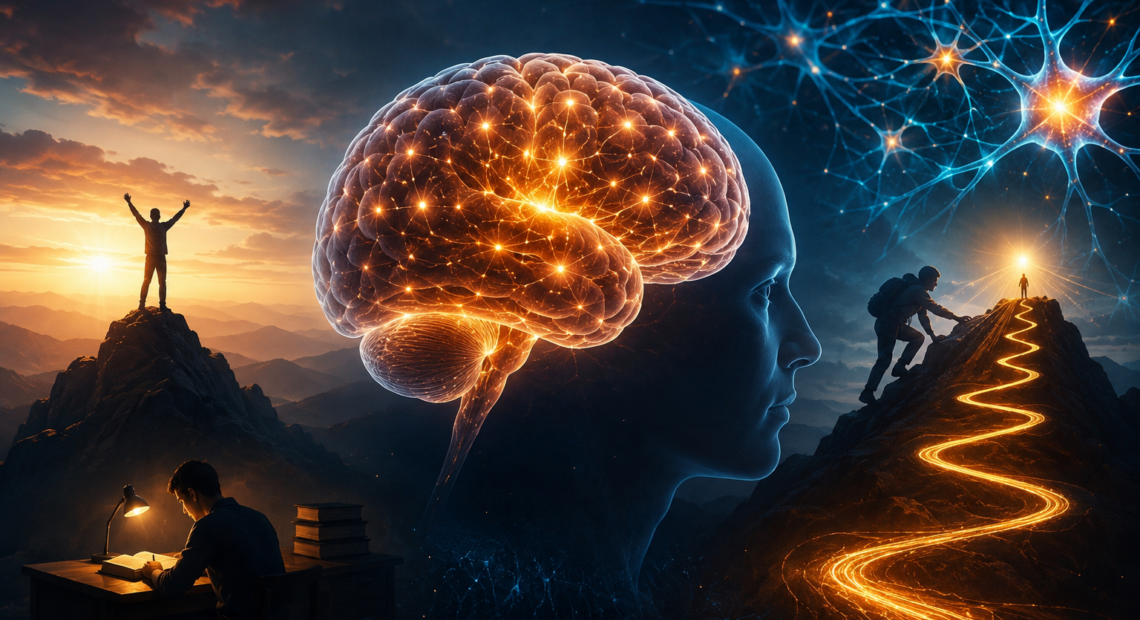
For decades, people believed that success was largely determined by IQ. But modern neuroscience tells a far more fascinating story. The most successful people are not necessarily the smartest. They are often the individuals whose brains have developed certain powerful neural traits—focus, resilience, emotional regulation, delayed gratification, adaptability, and perseverance. Success, it turns out, is deeply rooted in how the brain works.
And the good news?
Many of these brain circuits can be strengthened.
The Brain’s CEO: The Prefrontal Cortex
If the human brain were a corporation, the prefrontal cortex would be the CEO.
Located just behind the forehead, this region helps us:
- Plan for the future
- Control impulses
- Make decisions
- Stay focused
- Resist distractions
- Persist toward long-term goals
Studies consistently show that highly successful individuals tend to have stronger executive functioning abilities. They can say “no” to immediate pleasure in order to achieve a larger future reward. While others quit when things become difficult, they stay the course.
Their brains are constantly asking:
“What will help me most five years from now?”
instead of
“What feels good right now?”
The Marshmallow Experiment: A Study That Shocked the World
One of the most famous psychological experiments was conducted by psychologist Walter Mischel on delayed gratification.
Children were offered a simple choice:
Eat one marshmallow now.
Or wait a few minutes and receive two marshmallows.
The fascinating part came years later.
Researchers found that the children who delayed gratification tended to have better academic performance, healthier lifestyles, and greater career success later in life. The ability to wait for a larger reward reflected stronger self-control circuits within the brain. Success wasn’t about intelligence. It was about impulse control.
Why Some People Never Give Up
Every successful person experiences failure. The difference is that their brains respond differently to setbacks. Neuroscientists have discovered that resilient individuals show greater activity in brain networks involved in emotional regulation.
When faced with failure, they do not interpret it as:
“I am a failure.”
Instead they think:
“This is feedback.”
This mindset keeps stress hormones from overwhelming the brain.
Repeatedly overcoming challenges strengthens neural pathways associated with perseverance.
Like muscles, resilience grows through use.
Every obstacle becomes a training session for the brain.
The Dopamine Myth
Most people think dopamine is the “pleasure chemical.” That is only partially true. Dopamine is actually more closely related to motivation and pursuit. It is the molecule that makes us chase goals.
The most successful people often learn how to use dopamine wisely. Instead of seeking constant short-term rewards from social media, endless scrolling, junk food, or instant entertainment, they train their brains to derive satisfaction from progress itself.
Every small achievement triggers dopamine release.
A completed chapter.
A finished workout.
A solved problem.
A business milestone.
Over time, their brains become addicted not to comfort—but to growth.
The Dangerous Age of Distraction
Never in human history has the brain faced so many distractions.
Notifications.
Short videos.
Endless scrolling.
Instant entertainment.
Every interruption pulls attention away from deep thinking.
Neuroscience shows that constantly switching tasks reduces productivity and increases mental fatigue. Multitasking and attention research from Stanford University found that heavy multitaskers often perform worse on tasks requiring concentration. Ironically, people who try to do everything simultaneously often accomplish less.
The world’s highest achievers tend to protect their attention fiercely.
They understand a simple truth:
Attention is the currency of success.
Where attention goes, achievement follows.

The Growth Mindset Brain
Why do some people thrive after failure while others collapse?
Growth Mindset research by Carol Dweck, psychologist provides an answer.
People with a “fixed mindset” believe abilities are largely predetermined.
People with a “growth mindset” believe skills can improve through effort and learning.
Brain imaging studies suggest that individuals with a growth mindset show greater engagement with mistakes. Their brains literally pay more attention to learning opportunities.
This creates a powerful cycle:
Mistake → Learning → Improvement → Confidence → Greater Success
The brain becomes a self-improving machine.
The Hidden Power of Emotional Intelligence
Many brilliant individuals never reach their potential.
Why?
Because success requires more than intelligence.
It requires emotional intelligence. The ability to understand emotions, communicate effectively, manage conflict, and build relationships activates neural systems that are essential for leadership.
People who can inspire others often achieve far more than those who rely solely on technical knowledge.
History repeatedly demonstrates this principle.
Leaders change nations.
Innovators build companies.
Visionaries inspire movements.
None succeed alone.
The social brain is one of humanity’s greatest evolutionary advantages.
The London Taxi Driver Study
One of the most remarkable neuroscience studies involved London’s taxi drivers -The Driver hippocampal neuroplasticity study led by Eleanor Maguire
To obtain a taxi license, drivers must memorize thousands of streets and landmarks. Researchers discovered that these drivers had enlarged regions within the hippocampus—the brain’s memory center. Their brains physically changed in response to intense training.
This finding revealed something revolutionary:
The brain is not fixed. It rewires itself according to how it is used. This phenomenon, known as neuroplasticity, is one of the most important discoveries in neuroscience. Your brain today is not your brain five years from now. It is constantly being shaped by your habits.
Daily Habits That Rewire the Brain for Success
Neuroscience suggests several habits consistently strengthen success-related brain networks:
1.Deep Focus
Spend uninterrupted periods working on meaningful goals.
2.Regular Exercise
Exercise increases blood flow to the brain and promotes neural growth.
3.Quality Sleep
During sleep, the brain consolidates memories and clears metabolic waste.
4.Lifelong Learning
Learning new skills stimulates neuroplasticity.
5.Reading
Books train sustained attention in a way that social media cannot.
6.Meditation
Even a few minutes daily can strengthen attention and emotional regulation circuits.
- Meaningful Relationships
Positive social connections improve mental resilience and long-term wellbeing.
Three Real Stories of the Neuroscience of Success
1.The Boy Who Was Told He Was “Too Slow”
When Thomas Edison was a child, his teachers reportedly considered him difficult to teach. He struggled in the traditional classroom environment and was often viewed as slow. Most people would have accepted that label.
Edison didn’t. Neither did his mother.
Instead of allowing a temporary setback to define his future, he became relentlessly curious. He spent countless hours experimenting, failing, and trying again. Years later, after thousands of unsuccessful attempts to develop a practical light bulb, a journalist asked him about his failures.
Edison famously replied that he had not failed thousands of times; he had discovered thousands of ways that would not work. This is a perfect example of what neuroscientists now call a growth mindset. Every failed experiment strengthened learning circuits in his brain. Rather than interpreting failure as defeat, he viewed it as information.
The lesson?
The brain grows strongest not when everything goes right, but when we repeatedly learn from what goes wrong.
2.The Basketball Player Nobody Wanted
Before becoming one of the greatest athletes in history, Michael Jordan experienced a crushing disappointment. As a teenager, he was cut from his high school’s varsity basketball team.
Imagine that.
The man many consider the greatest basketball player ever was once told he wasn’t good enough.
Most people would have quit. Jordan did the opposite. The rejection became fuel.
He practiced relentlessly, often before school and long after others had gone home.
Years later he reflected:
“I’ve failed over and over and over again in my life. And that is why I succeed.”
Modern neuroscience explains why.
Each time Jordan pushed through discomfort, he strengthened neural pathways associated with perseverance, discipline, and delayed gratification. Talent may have opened the door. But it was thousands of hours of focused practice that transformed his brain into that of a champion.
3.The Single Mother Rejected Again and Again
Before the world knew her as a literary phenomenon, J. K. Rowling was a struggling single mother living on limited means. She had written a manuscript about a young wizard named Harry Potter.
Publisher after publisher rejected it.
One rejection.
Then another.
Then another.
Twelve publishers reportedly turned the manuscript down.
Most aspiring authors would have stopped there. Rowling didn’t. She continued because she believed in her story even when nobody else did.
Eventually one publisher took a chance on the book. The result was one of the most successful literary franchises in history.
From a neuroscience perspective, Rowling demonstrated remarkable emotional resilience. Instead of allowing repeated rejection to trigger surrender, she kept her long-term goal alive.
Her story reminds us that success often belongs not to the person with the fewest setbacks, but to the person who survives the most of them.
What These Three Stories Have in Common
At first glance, an inventor, a basketball player, and an author seem to have little in common.
Yet their brains displayed the same powerful characteristics:
They tolerated failure.
They delayed gratification.
They persisted when others quit.
They continued learning despite setbacks.
They refused to let temporary circumstances define their future.
The neuroscience of success suggests that these qualities matter more than raw talent alone.
Edison was not remembered for his failures.
Jordan was not remembered for being cut from a team.
Rowling was not remembered for her rejection letters.
They are remembered because they trained their brains to keep moving forward when moving forward was hardest.
The Most Important Discovery of All
Perhaps the most encouraging finding from modern neuroscience is this:
Success is not reserved for a lucky few. The brain remains adaptable throughout life. Every day you strengthen certain neural pathways and weaken others. Every choice is a vote for the person you are becoming.
The student who studies despite distractions.
The athlete who trains despite fatigue.
The entrepreneur who persists despite failure.
The artist who continues despite criticism.
They are all performing the same act.
They are rewiring their brains.
The neuroscience of success ultimately reveals a profound truth: Extraordinary achievement is rarely the result of extraordinary talent alone. More often, it is the result of ordinary people repeatedly strengthening the neural circuits that support focus, perseverance, learning, and resilience.
Success is not merely something we achieve. It is something we build—one neural connection at a time. It’s rarely determined by what happens to us. It is determined by how our brains respond to what happens to us.
Pic courtesy: Pegasus/ images are subject to copyright