Social Housing: The Missing Foundation Of Viksit Bharat

By,
Ravi Saini
Associate Editor, Unique Times &
CEO, RSW (Resetting Sustainable
Wealth) Group
A National Development Priority
India’s transformation is visible in its highways, airports, industrial corridors, digital networks and expanding cities. Yet millions of families still struggle to find a decent, affordable home near employment, schools and healthcare. The central question for Viksit Bharat 2047 is whether India can become a developed nation without ensuring access to dignified, affordable and sustainable housing.
Development is experienced inside homes and communities: in secure shelter, dependable water and electricity, safe neighbourhoods, accessible healthcare, good schools and reasonable journeys to work. Social housing should therefore be treated not merely as welfare or a count of dwelling units, but as core economic and social infrastructure.
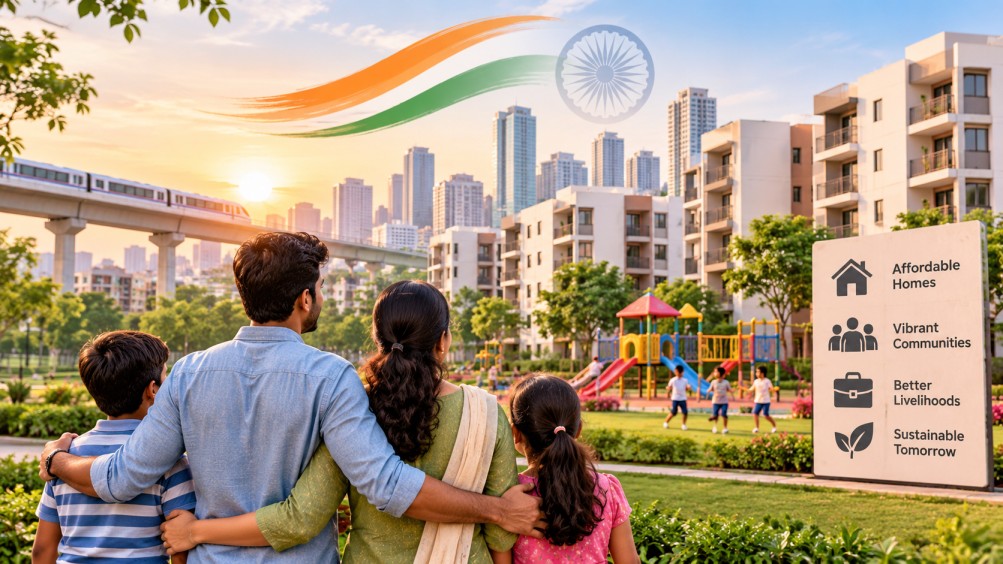
The policy shift is from “housing for all” to “communities for all”. A house provides shelter; a well-planned community enables families to live, work, learn, access services and build economic security.
Beyond Four Walls: Integrated Urban Clusters
Housing should be planned alongside schools, vocational training, healthcare, local shopping, public transport, parks, playgrounds, community centres and employment opportunities. Reliable water, sewage treatment, waste management, renewable energy and digital connectivity should be designed in from the beginning.
The Integrated Urban Cluster approach envisages comprehensive development units that combine homes, community services, employment linkages and essential infrastructure. Clusters can begin at a manageable scale and expand as population and economic activity grow. They should meet residents’ daily needs while remaining connected to the wider region—not become isolated settlements.
Planning housing and employment together is essential. Every major industrial or economic development should ask where its workers will live; every major housing project should ask where residents will earn their livelihoods. Bringing jobs closer to homes can reduce commuting time, transport costs and energy use, while giving families more time.
Dignified Homes, Resilient Infrastructure
Affordable must never mean inferior. Homes should be safe, comfortable, durable and adaptable to different household needs, including those of young families, older residents and persons with disabilities. Designs and materials must respond to local climate, geography and culture. Affordability should be measured over the life of the home—not only by its initial price.
Prefabrication, modular construction, standardised components and industrialised building processes can potentially improve quality, shorten construction time and create economies of scale. Standardisation, however, should not erase differences in family needs or regional conditions.
- Energy: rooftop solar and suitable storage can support energy resilience, with technology selected according to local conditions, economics and regulation.
- Water: sustainable local sources may supplement supply where feasible; wastewater treatment and reuse can reduce pressure on freshwater, subject to quality monitoring and applicable standards.
- Connectivity and services: reliable broadband, mobile networks, transport, waste management and community facilities support education, healthcare, work and emergency response.
The objective is practical resilience and lower long-term operating costs—not technological extravagance. Build what is required today, but design for tomorrow.
A Productive and Financially Sustainable Model
Large-scale housing can stimulate demand across cement, steel, electrical equipment, plumbing, tiles, sanitaryware, furniture, logistics, engineering and construction technology. Combined with modern construction methods, a national programme could support domestic manufacturing, skills and employment. Social housing is therefore a cross-sectoral economic programme, touching urban development, infrastructure, finance, manufacturing, energy, water and social welfare.
Public expenditure alone is unlikely to meet the scale of the challenge. Government has a critical role in policy direction, land-use frameworks, infrastructure, approvals, targeted affordability measures and beneficiary safeguards; it need not build every home itself. Carefully structured partnerships can bring together government agencies, public-sector institutions, private developers, financial institutions, technology providers and long-term investors.
The guiding principle should be: “Public purpose with private efficiency, under transparent rules.” Investment, responsibilities and risks must be allocated project by project. Land, construction, infrastructure, financing, affordability and maintenance must be considered together. Financial feasibility is essential: a project that cannot sustain its infrastructure and upkeep will deteriorate regardless of its initial construction success.
Housing policy should also create responsible pathways to asset ownership without pushing families into unsustainable debt. Appropriate credit assessment, transparent finance, targeted guarantees where justified, and suitable rental or rent-to-own options can help households build security.
A National Mission with Measurable Outcomes
Social housing merits recognition as a coordinated, multi-year national mission involving relevant ministries, public institutions, state governments, urban local bodies and private-sector participants. Broad national standards can be combined with local adaptation. A successful cluster model should be replicable, while design, materials, energy, water and employment solutions respond to regional circumstances.
The mission should be assessed by more than the number of homes constructed. A practical ten-question test is whether:
- children can safely reach school;
- workers can reach employment without losing hours each day;
- residents, including older people, can access healthcare;
- families can afford essential utility bills;
- parks and community spaces are available;
- public transport is accessible;
- local jobs and small-business opportunities exist;
- homes are resilient to heat, flooding and other environmental pressures;
- infrastructure can reliably support the community; and
- families feel secure about their future.
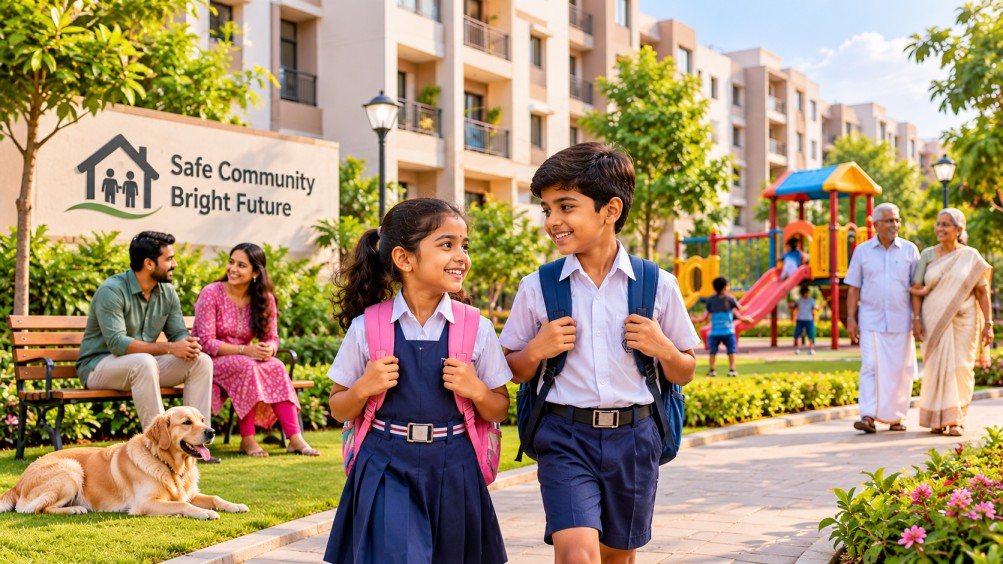
These measures capture the difference between constructing houses and creating functioning communities. The goal is to move from a beneficiary-only approach to a stakeholder model in which residents are part of a productive economic ecosystem.
Viksit Bharat Begins at the Doorstep
India’s 2047 ambition should be judged not only from the top of a skyscraper, but from the doorstep of an ordinary home. Highways connect cities, airports connect economies and digital networks connect people—but homes connect families to the future.
The ambition should be to create millions of dignified homes within sustainable, connected and economically vibrant communities. Build the home. Build the community. Build the infrastructure. Build the opportunity.
A developed India will be measured not simply by how many buildings it constructs, but by how many families can say: “This is our home, this is our community, and this is our future.”
Pic courtesy: google/ images are subject to copyright