FROM FIRST APPEAL TO SECOND APPEAL: COMPLETING THE GST DISPUTE CHAIN


By,
Adv Sherry Samuel Oommen: This article is authored by Adv Sherry Samuel Oommen. He special
ises in the Constitution, tax and corporate laws and has also cleared the final exams of the In
stitute of Chartered Accountants of India, the Institute of Cost Accountants of India and the
Institute of Company Secretaries of India. He has also completed his Masters’s Degree in Com
merce, apart from obtaining a Post Graduate Diploma in Business and Corporate Laws from Sym
biosis, Pune. The views expressly are personal and should not be construed as a legal opinion.
sherryoommen@nashcp.com
The Goods and Services Tax Appellate Tribunal, better known as GSTAT, is one of the most important institutional developments in India’s GST journey. GST was introduced with the promise of a unified indirect tax system, but for several years one critical part of the dispute-resolution structure remained incomplete: a fully functional second appellate forum. Taxpayers could file a first appeal before the departmental appellate authority, but in the absence of GSTAT, many matters travelled to High Courts through writ petitions, even where the dispute was mainly factual — such as reconciliation, input tax credit, valuation, classification, refund rejection, cancellation of registration or penalty, thereby clogging the system. The GSTAT, Ernakulam Bench for Kerala and Lakshadweep has been operational since March 2026 in a temporary office. One cannot await the day when the GSTAT starts functioning at its permanent office.
Moving on, the Union Finance Minister formally launched GSTAT in New Delhi on 24 September 2025. The Government described GSTAT as a statutory appellate body constituted to hear appeals against orders passed by GST appellate authorities and to provide taxpayers with an independent forum for justice. GSTAT is designed to function through a Principal Bench in New Delhi and 31 State Benches across 45 locations, giving the institution both national reach and regional accessibility. Each Bench is expected to combine judicial and technical expertise, with Judicial Members and Technical Members from both the Centre and the States.
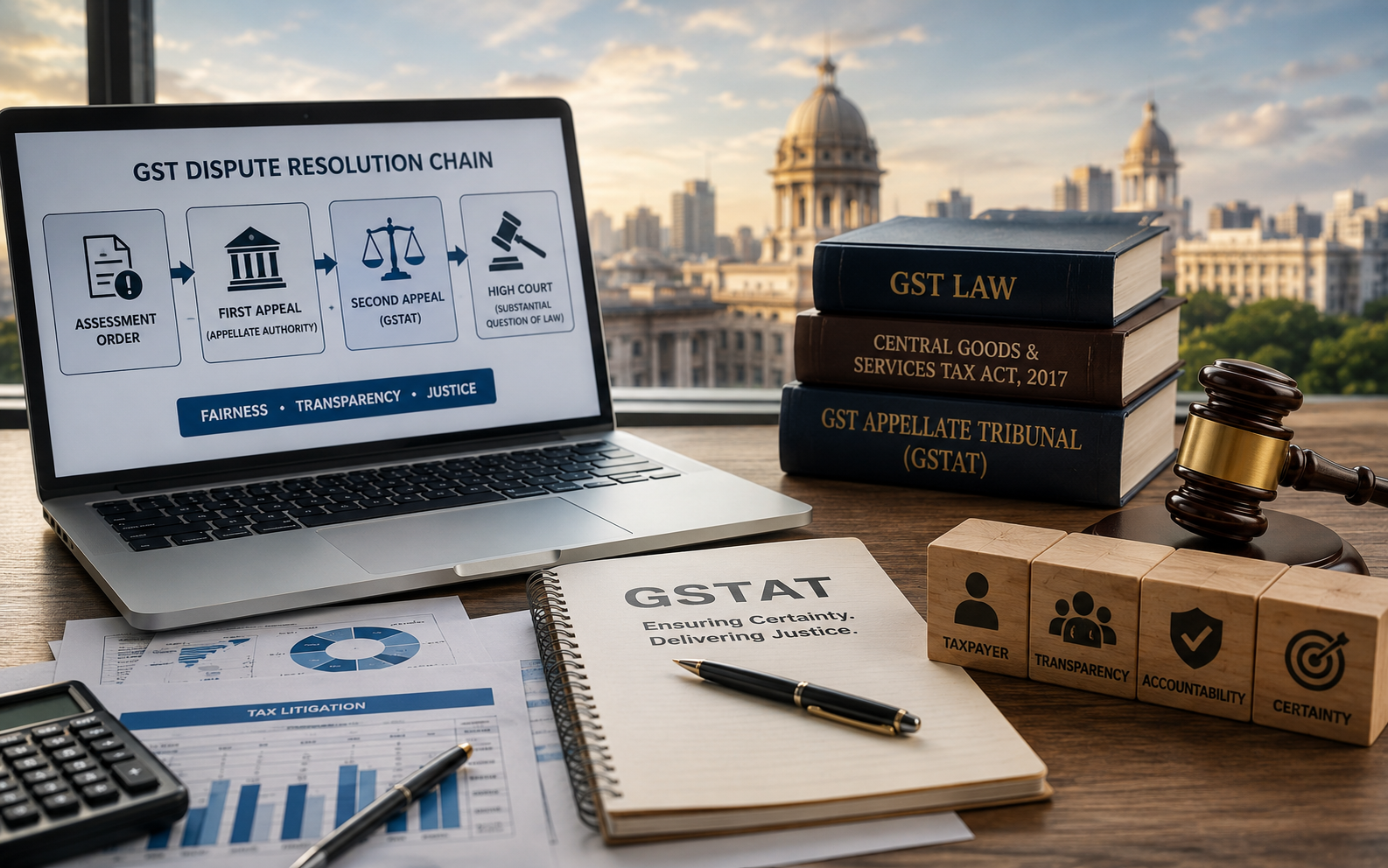
The launch of GSTAT is not merely an administrative event. It completes a missing link in the GST appellate chain. The first appeal under GST lies before the Appellate Authority under section 107 of the Central Goods & Services Tax Act, 2017 (“CGST Act” or “the Act”). The second appeal lies before the Appellate Tribunal under Section 112 of the CGST Act. At this stage, disputes arising from both Central and State GST administrations also comes before this specialised forum. This is why GSTAT is expected to bring greater consistency in interpretation, predictability in outcomes and credibility to GST litigation. One would also expect the lower authorities to follow the binding precedent of the GSTAT.
The immediate policy background was the 56th GST Council meeting held on 3 September 2025. The Council recommended that GSTAT should be made operational for accepting appeals before the end of September 2025 and should commence hearings before the end of December 2025. It also recommended 30 June 2026 as the limitation date for filing backlog appeals. As of today, the most important practical fact is the deadline. For orders communicated before 1 April 2026, the appeal before GSTAT may be filed up to 30 June 2026. For orders communicated on or after 1 April 2026, the normal limitation period of three months from the date of communication applies. This position has been notified through S.O. 4220(E) dated 17 September 2025, issued under section 112(1) of the CGST Act.
This deadline should not be treated casually. Many taxpayers have orders passed under section 107 or section 108 which could not earlier be appealed before GSTAT because the Tribunal was not operational. These are the backlog matters. Every taxpayer and counsel should immediately identify all such orders, check the date of communication, verify whether the order is uploaded on the GST portal, confirm whether any demand ID or recovery entry exists, and decide whether the matter should be filed before GSTAT before 30 June 2026. It would not be apposite to state that appeals would need to be filed electronically in accordance with GSTAT (Procedure) Rules, 2025.
The Tribunal stage is especially important because GSTAT is the final serious stage for establishing facts. Once the matter moves beyond GSTAT, the appeal is generally narrower. An appeal from the State Bench of the Tribunal to the High Court lies only where the High Court is satisfied that the case involves a substantial question of law. Therefore, weak factual preparation at GSTAT can seriously prejudice the taxpayer later.
The appeal should be prepared like a proper litigation file, not like a routine portal filing. The usual documents include the show cause notice, reply, order-in-original, first appeal, order-in-appeal, statement of facts, grounds of appeal, computation of demand, pre-deposit proof, relied-upon judgments, authorisation or vakalatnama, affidavits wherever required, and condonation application if there is delay. One should also ensure proper indexing, pagination, legible scanning, translation where required, correct classification of the dispute and consistency between the facts pleaded and the documents uploaded.
Pre-deposit is one of the most important areas where taxpayers make mistakes. Under section 112(8) of the CGST Act, an appeal before GSTAT cannot be filed unless the appellant pays the admitted amount in full and, in addition, pays 10% of the remaining amount of tax in dispute. This is in addition to the amount already paid at the first appellate stage under Section 107(6) of the Act, subject to the statutory cap. Once the amount under Section 112(8) of the Act is paid, recovery proceedings for the balance amount are deemed to be stayed till disposal of the appeal.
In practical terms, many taxpayers will already have paid 10% of the disputed tax at the first appeal stage. At the GSTAT stage, they generally need to pay a further 10% of the remaining disputed tax. Therefore, the cumulative statutory pre-deposit across the first and second appeal stages may broadly come to around 20% of the disputed tax, subject to the exact facts, statutory caps, admitted liability and the nature of the order. Taxpayers must not confuse admitted demand with disputed demand. The admitted amount must be paid fully; pre-deposit applies only to the disputed portion.
The question of recovery during the period when GSTAT was not functional had earlier created serious hardship. CBIC Circular No. 224/18/2024-GST clarified that where the first appellate authority had confirmed a demand and the taxpayer intended to appeal before the Tribunal, the taxpayer could pay an amount equivalent to the required section 112 pre-deposit and file an undertaking that the appeal would be filed when the Tribunal became operational. On such compliance, recovery of the remaining confirmed demand would stand stayed under section 112(9).
Recent High Court decisions show why this point matters. In Supreme Infotrade Pvt. Ltd. vs. Assistant Commissioner of State Tax (2025) 33 Centax 251 (Cal.) [06-08-2025], the Department had recovered the entire tax demand even before the statutory appeal period expired. The Court held that the authorities committed a grave error in recovering the demand before expiry of the appeal period and directed refund of the balance amount after retaining only the permissible statutory percentage, considering sections 107(6) and 112(8).
A major 2026 development relates to GSTAT’s role in advance ruling disputes. The Finance Act, 2026 received the President’s assent on 30 March 2026. Section 156 of the Finance Act, 2026 came into force on 1 April 2026 and inserted a new sub-section (1A) in section 101A of the CGST Act. This new provision says that until the National Appellate Authority for Advance Ruling is constituted under section 101A(1) of the Act, the Government may, on the recommendation of the GST Council and by notification, empower any existing authority constituted under any law to hear appeals under Section 101B of the Act. The explanation specifically states that “existing Authority” includes a Tribunal.
This amendment is important because Section 101B of the CGST Act deals with conflicting advance rulings. Where Appellate Authorities for Advance Ruling of two or more States or Union Territories give conflicting advance rulings on the same question, an eligible applicant or authorised officer may appeal to the National Appellate Authority. The appeal by an applicant is generally required to be filed within 30 days from communication of the last conflicting ruling, with a further condonable period not exceeding 30 days.
The correct present legal position should therefore be stated carefully. The GST Council has recommended that the Principal Bench of GSTAT will serve as the National Appellate Authority for Advance Ruling. The Finance Act, 2026 has created the statutory mechanism to empower an existing authority, including a Tribunal, to perform that function until the regular National Appellate Authority is constituted. The Government vide Notification 18/2024 dated 07.05.2026 has notified the Principal Bench of GSTAT to hear appeals under Section 101B of the CGST Act.
This development matters for businesses operating in multiple States. Under GST, advance rulings have often been useful, but they have also produced uncertainty because different State authorities have sometimes taken different views on classification, rate, exemption, input tax credit or the nature of a transaction. A national-level appellate mechanism can reduce such inconsistency. If the Principal Bench of GSTAT performs this function effectively, it can help bring certainty to transactions that otherwise face different tax treatment in different States.
For ordinary GSTAT appeals, the most common disputes are expected to involve input tax credit, mismatch between returns, supplier default, classification, valuation, refund rejection, cancellation of registration, e-way bill penalties, credit notes, place of supply and procedural non-compliance. In such matters, taxpayers should not rely only on legal arguments. GSTAT will examine the facts. Books of account, invoices, credit notes, ledgers, e-way bills, GSTR-1, GSTR-3B, GSTR-2B, annual returns and reconciliation statements will often decide the strength of the case.
Mismatch disputes require special care. A difference between GSTR-1 and GSTR-3B, or between purchase register and GSTR-2B, is not automatically proof of tax evasion. At the same time, it is not automatically a clerical error. The taxpayer must explain the mismatch through documents. For example, the difference may arise due to credit notes, amendments, advances, year-end adjustments, wrong-period reporting, supplier reporting errors or cancellation entries. A strong appeal should tell the factual story clearly and support every claim with evidence.
For Counsels, GSTAT practice will require a combination of law, accounting, technology and litigation discipline. The statement of facts should be concise but complete. The grounds of appeal should identify the exact legal and factual errors in the impugned order. The prayer should be specific. The demand computation should be understandable. The supporting documents should be arranged in a manner that allows the Bench to follow the dispute without confusion. Poor drafting, vague grounds, unreadable annexures and incomplete reconciliations can weaken even a good case.
Taxpayers should also review recovery exposure. If recovery has already been made beyond the statutory pre-deposit requirement, the decisions in Supreme Infotrade (supra) and Vidya Trading Co. (2026) 38 Centax 35 [Cal] become important references. In the case of Vidya Trading Co (supra), the Calcutta High Court was pleased to hold that once the pre-deposit as mandated in law (ie, 10 percent of the disputed tax) is paid, the balance amount is deemed to be automatically stayed having regard to the provisions of Section 112(9) of the CGST Act. In the said case, the Department was directed to recredit the amounts illegally collected over and above the mandated pre-deposit.
The beginning of GSTAT should therefore be seen as both an opportunity and a warning. It is an opportunity because taxpayers finally have a specialised second appellate forum. It is a warning because limitation, pre-deposit, court fee, documentation and portal compliance can no longer be postponed. The 30 June 2026 date is not far away. Every pending order should be reviewed now, every disputed demand should be recomputed, every document should be indexed, and every appealable matter should be prepared well before the last week.
If GSTAT functions with independence, speed and consistency, it can reduce unnecessary writ litigation, improve taxpayer confidence and bring much-needed certainty to indirect tax disputes. But its success will also depend on how taxpayers and counsels approach it. GSTAT should not be treated as another routine compliance portal. It is the final serious forum for facts under GST, and the quality of preparation at this stage may decide the future of the dispute.
Pic courtesy: Pegasus/ images are subject to copyright