Indian Knowledge System
By,
Ravi Saini
Associate Editor, Unique Times &
CEO, RSW (Resetting Sustainable Wealth) Group
A National Asset for Every Citizen, Not Just the Privileged: Why the Indian Knowledge System Must Empower the Last Citizen First
India stands at a defining moment in its journey towards becoming a developed nation. Economic growth has accelerated, technological capabilities are expanding, and India is increasingly recognised as a global leader. Yet, a fundamental question remains:
Who Should Benefit from India’s Progress?
The Indian Knowledge System (IKS) represents one of the world’s oldest and richest civilisational traditions. It encompasses education, ethics, governance, science, medicine, agriculture, architecture, philosophy, mathematics, environmental stewardship, and social responsibility. However, if IKS remains confined to academic institutions or becomes a privilege available only to policymakers, industrialists, or elite institutions, its true purpose will remain unfulfilled.
The real success of IKS will be measured by its ability to improve the lives of farmers, labourers, students, women, entrepreneurs, and ordinary citizens. Knowledge should become a national equaliser rather than another exclusive advantage.
The Need for Inclusive Development
India’s greatest strength lies in its people. Every election reminds us that governments derive their authority from citizens. Likewise, every economy survives because consumers sustain production and demand. Policies that focus exclusively on capital creation without equal attention to human development risk widening inequality. Economic prosperity cannot be considered complete if millions continue to lack access to quality education, skill development, healthcare, and opportunities for personal growth. The Indian Knowledge System should therefore become the foundation of inclusive nation-building, where economic development and character development progress together.
Character Before Career
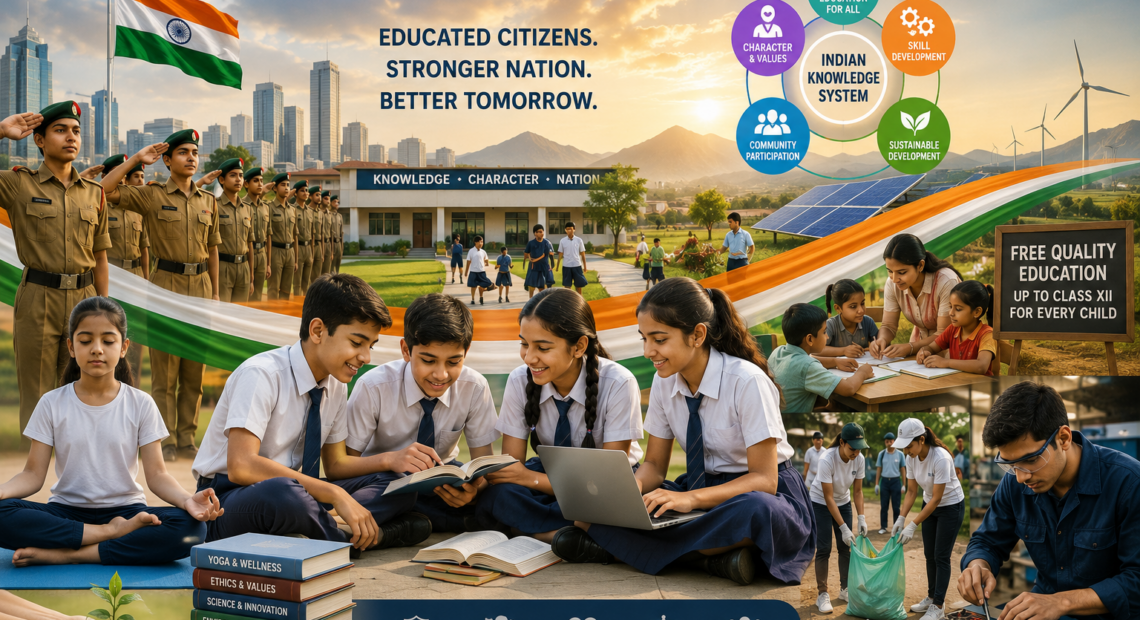
One of the most urgent reforms India requires is the reintroduction of structured character education. Academic excellence alone cannot produce responsible citizens. Integrity, discipline, empathy, respect for the Constitution, environmental responsibility, financial literacy, teamwork, and civic duty should become integral components of school education.
Daily activities may include:
- Yoga and meditation
- Physical fitness and endurance training
- Community service
- Leadership exercises
- Disaster management awareness
- Environmental conservation
- Financial responsibility
- Digital ethics
- Constitutional values
- Respect for diversity and national unity
A nation becomes strong when its citizens possess both competence and character.
Armed Forces-Inspired School Governance
India’s Armed Forces are admired worldwide for discipline, leadership, teamwork, and commitment to national service. Schools need not become military institutions, but they can adopt proven principles of organised leadership and accountability.
Such a model could include:
- Morning assemblies focused on leadership and national values.
- Student leadership houses with clearly defined responsibilities.
- Uniform standards of punctuality and discipline.
- Team-based projects that encourage cooperation rather than unhealthy competition.
- Physical fitness programmes suitable for every age group.
- Emergency preparedness and disaster response training.
- Regular community service initiatives.
These practices would develop confident, responsible, and resilient young citizens while strengthening respect for democratic institutions.
Free Education up to Class XII
Education should never become a privilege determined by family income. India should progressively work towards ensuring free education up to Class XII for every child. This objective may be achieved through a partnership involving:
- Government funding
- Corporate Social Responsibility (CSR)
- Philanthropic foundations
- Public-Private Partnerships
- Community participation
CSR funds can support:
- School infrastructure
- Digital classrooms
- Science laboratories
- Libraries
- Sports facilities
- Scholarships
- Teacher training
- Nutrition programmes
Such investment is not charity—it is nation-building.
Framework for National Development
A development model built upon five pillars:
- Universal Quality Education accessible to every child.
- Character Building through ethics, discipline, and civic responsibility.
- Skill Development aligned with future industries and entrepreneurship.
- Community Participation involving government, industry, civil society, and educational institutions.
- Sustainable Wealth Creation where prosperity reaches every section of society.
This approach reflects the principle that national wealth should include educated citizens, healthy communities, ethical leadership, and social harmony—not merely financial indicators.
Expanding Access Through Evening Colleges and Universal Education Finance
One of India’s greatest educational challenges is not the absence of talent but the limited availability of opportunities. Every year, lakhs of deserving students fail to secure admission to their preferred colleges due to capacity constraints, cut-off criteria, financial limitations, or personal responsibilities. Many never return to higher education, resulting in a significant loss of human potential.
To address this gap, Indian universities should consider expanding accredited Evening Colleges or evening undergraduate programmes. Such institutions would provide a second opportunity for students who could not secure admission during the regular admission cycle, while also serving working professionals, entrepreneurs, women with family responsibilities, defence personnel, athletes, and individuals seeking to upgrade their qualifications.
Evening colleges would make better use of existing university infrastructure by extending academic hours, thereby increasing enrolment capacity without proportionately increasing capital expenditure. This approach can improve the utilisation of classrooms, laboratories, libraries, and faculty resources while reducing pressure on creating entirely new campuses.
At the same time, financial barriers remain one of the leading causes of higher education dropouts. A national policy providing 100% education loans for undergraduate programmes, subject to transparent eligibility criteria and academic progress, could ensure that no deserving student abandons higher education solely because of financial hardship.
To strengthen employability and improve loan repayment capacity, undergraduate programmes should incorporate structured internships, apprenticeships, or industry attachments as a compulsory component of the curriculum. Exposure to real workplaces enables students to acquire practical skills, professional discipline, and industry experience while building networks that improve employment prospects after graduation.
This integrated approach offers multiple advantages:
- Increased Gross Enrolment Ratio (GER) in higher education.
- Reduced student dropouts due to financial constraints.
- Better utilisation of university infrastructure through evening programmes.
- Stronger industry-academia collaboration.
- Enhanced employability through practical work experience.
- A more skilled workforce aligned with India’s economic and industrial priorities.
- Improved repayment capacity for education loans through higher employment outcomes.
Education should not be limited by admission timing or family income. A flexible higher education system—supported by evening colleges, universal access to education finance, and compulsory internships—would ensure that talent is nurtured rather than lost. Such reforms would contribute to a more inclusive, productive, and knowledge-driven India, fully aligned with the aspirations of a developed nation.
A Call to Government and Industry
Government, educational institutions, industries, and civil society must work together to ensure that the Indian Knowledge System becomes a practical framework for national transformation. Industrialists and investors have an essential role as partners by contributing innovation, employment, technology, and CSR resources. However, the ultimate beneficiaries must remain the citizens of India. A developed India cannot be built by economic growth alone. It must also be built through educated minds, disciplined youth, ethical leadership, and empowered communities.
Conclusion
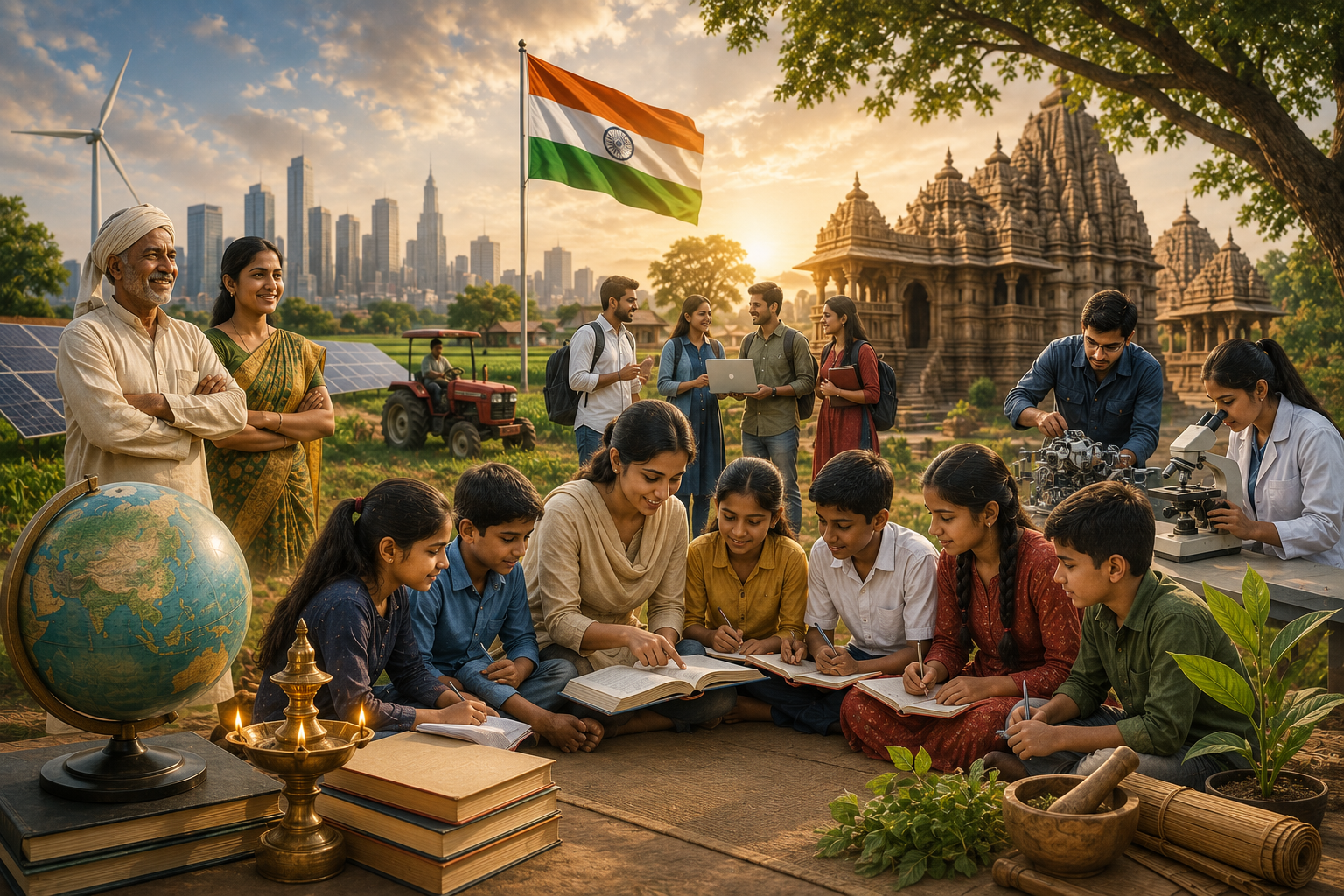
India possesses one of the richest knowledge traditions in human history. The challenge before us is not only preserving that heritage, but also applying it to contemporary national development. If we combine the wisdom of the Indian Knowledge System with universal education, character building, disciplined school governance, and inclusive economic participation, India can create a development model that inspires the world.
The future of India should not belong only to those who possess capital. It should belong equally to every child who dreams, every farmer who feeds the nation, every worker who builds it, every teacher who shapes its future, and every citizen who believes that knowledge must serve humanity. Only then will the Indian Knowledge System fulfil its true purpose—Knowledge for All, Development for All, and Prosperity for All.
A nation is ultimately measured not only by the size of its economy, but by the quality of its citizens. When knowledge is accessible to every child, opportunity reaches every family, and character becomes the foundation of leadership, India can emerge as a truly developed nation—economically prosperous, socially just, ethically strong, and globally respected.
The true success of the Indian Knowledge System will not be measured by the number of policies written or institutions established, but by the number of lives transformed.
Picture Courtesy: Pegasus/ Images are subject to copyright